


STEM for Little Learners: Simple Ways to Spark Curiosity

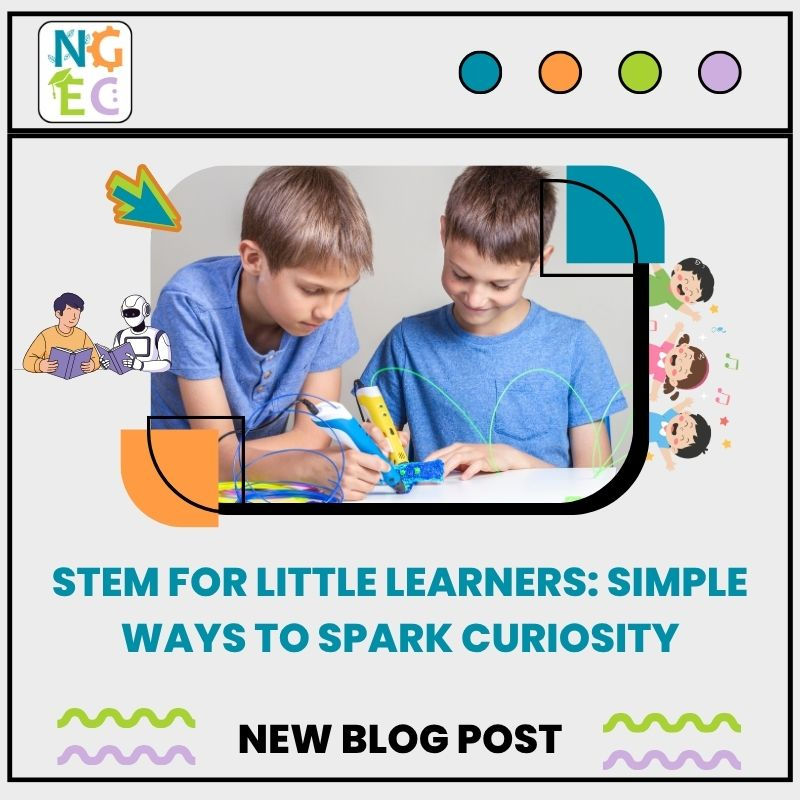
🌟 Introduction — How Do Young Children Become Natural Scientists and Inventors?
Have you ever watched your child drop something just to see what happens, mix random materials together, or ask “why?” ten times in a row? That’s STEM in action — long before they ever step into a classroom. STEM (Science, Technology, Engineering, and Math) isn’t about complicated experiments or fancy equipment. It’s about curiosity, exploration, problem‑solving, and hands‑on discovery — all things young children naturally excel at.
Let’s explore simple, joyful ways to spark STEM thinking in little learners right at home.
🔬 1. Science: Exploring the World Through Wonder
Science begins with curiosity — observing, predicting, testing, and discovering.
Example: A child watching ice melt is learning about temperature, states of matter, and cause‑and‑effect.
How to spark it:
Freeze toys in ice and let children “rescue” them
Explore nature: leaves, rocks, bugs
Mix baking soda and vinegar for fizzy fun
Ask open‑ended questions like “What do you think will happen next?”
💻 2. Technology: Tools That Help Us Solve Problems
Technology for young children isn’t screens — it’s anything that helps them complete a task.
Examples:
Flashlights
Magnifying glasses
Funnels
Scissors
Simple coding toys
How to spark it:
Let children explore household tools safely
Use a flashlight to explore shadows
Introduce simple cause‑and‑effect toys
🧱 3. Engineering: Building, Designing, and Problem‑Solving
Engineering is all about creating solutions and testing ideas.
Example: A child building a tower that keeps falling is learning stability, balance, and persistence.
How to spark it:
Offer blocks, cardboard, tape, and recyclables
Build bridges for toy cars
Create ramps and test different objects
Encourage trial and error (“What else could you try?”)
🔢 4. Math: Patterns, Numbers, and Everyday Logic
Math is everywhere — in routines, play, and daily life.
Example: Sorting socks by colour or size is early math.
How to spark it:
Count steps, snacks, or toys
Make patterns with beads or cereal
Compare sizes (“Which cup holds more?”)
Talk about shapes during walks
🧠 5. Inquiry: Asking Questions and Testing Ideas
STEM thrives on curiosity. Children learn best when adults encourage them to wonder, explore, and experiment.
How to spark it:
Ask “What do you notice?” instead of giving answers
Encourage predictions
Celebrate mistakes as learning moments
Follow your child’s interests
🌈 6. Sensory Play: The Foundation of STEM Thinking
Sensory play helps children explore materials, test ideas, and observe changes.
Examples:
Water play
Sand and dirt
Playdough
Mixing colours
Pouring and scooping
These activities build scientific thinking, measurement skills, and problem‑solving.
🧩 7. Loose Parts Play: Creativity Meets Engineering
Loose parts are open‑ended materials children can move, stack, sort, and combine.
Examples:
Rocks
Sticks
Bottle caps
Fabric scraps
Cardboard tubes
Loose parts encourage design thinking, creativity, and experimentation.
🎮 8. Coding for Little Minds: Sequencing and Logic
Coding begins with simple concepts like order, direction, and cause‑and‑effect.
Examples:
Giving a stuffed animal “instructions”
Using arrows to show movement
Playing “robot” games where children follow steps
These activities build early computational thinking.
🏗️ 9. Real‑World Problem‑Solving
STEM is most powerful when connected to real life.
Examples:
“How can we build a shelter for your toy?”
“How can we make this ball roll faster?”
“What can we use to make this float?”
Children learn best when solving meaningful challenges.
💛 10. Celebrate Curiosity, Not Perfection
STEM is about exploration, not getting the “right” answer. Celebrate effort, creativity, and persistence.
Example: “You tried so many ways to make that ramp work — that’s real engineering!”
🌟 Conclusion — Your Child Is Already a STEM Thinker
STEM learning begins long before school — in every question, every experiment, every tower, every splash, and every “why?” Children are natural explorers, and with your support, they can grow into confident problem‑solvers and creative thinkers.
You don’t need special materials — just curiosity, encouragement, and a willingness to explore together. You’re helping your child build a lifelong love of learning.
This blog post was created with the assistance of AI.


Comments